Posted on

Sulfonated clay and carbon nanotubes Nafion™-based proton exchange membranes

Toyota fuel cell concept car

The demand for sustainable energy has accelerated the development of electrochemical systems for energy conversion. This includes, in particular, proton exchange membrane fuel cells (PEMFCs). PEMFCs offer numerous advantages, including high energy density, low operating temperatures, fast start-up times, and compact design. These characteristics make them especially suitable for mobile and decentralized energy applications. The development of high-performance proton exchange membranes is crucial for the advancement of fuel cell technology, particularly under demanding operating conditions.

The central component, the proton exchange membrane, is characterized by high proton conductivity, excellent chemical and physical stability, low gas permeability, and adequate water uptake under a variety of conditions. Nafion™, a perfluorosulfonic acid (PFSA) ionomer, is considered the gold standard for proton exchange membranes due to its outstanding proton conductivity and chemical resistance.

However, its performance degrades significantly at elevated temperatures (>80 °C) and low relative humidity due to excessive water loss. These limitations restrict its applicability in next-generation high-temperature fuel cells. To overcome these limitations, extensive efforts have been made to develop PFSA-based composite membranes. For this purpose, inorganic or organic fillers such as silica, metal oxides, and carbon-based nanomaterials have been used. These additives aim to improve water retention, mechanical strength, and thermal stability.

Italian researchers from the University of Calabria have developed Nafion™ membranes reinforced with sulfonated clay and carbon nanotubes to address issues with water retention and proton transport. They recently published their results in the journal Materials for Renewable and Sustainable Energy. The hybrid fillers created a synergistic effect. The clay improved the hydrophilic properties, while carbon nanotubes enhanced the structural integrity and conductivity.

In tests with hydrogen fuel cells at 120 °C and 20% relative humidity—conditions that typically severely impair normal PFSA membranes—the new composition achieved a peak power of 443 mW/cm². This was four times that of Nafion™ membranes. This breakthrough suggested that integrating nanofillers could yield further improvements in durability and efficiency of proton exchange membranes. At the same time, the experiments paved the way for robust fuel cells in the automotive and stationary energy sectors, where such performance improvements are particularly needed.

The incorporation of sulfonated clay and carbon nanotubes not only improved the ion exchange capacity and hydrolytic stability but also critically modulated the water dynamics. The result was superior water retention and sustained proton diffusion, particularly at elevated temperatures. The significantly higher proton conductivity under low humidity conditions was a crucial factor for the operation of high-temperature fuel cells in the study presented.

This study successfully demonstrated the significant potential of sulfonated clay and carbon nanotubes to enhance the performance and durability of Nafion-based proton exchange membranes for fuel cell applications. The incorporation of the additives also increased the structural integrity of the membrane. Dynamic mechanical analysis showed a significant reinforcement effect from the inclusion of the additives, with a consistent increase in storage modulus and a shift of the glass transition temperature to higher temperatures. For the improved membrane, the glass transition temperature increased from 120 °C for conventional Nafion to approximately 150 °C.

Moreover, the nanocomposite membrane exhibited a remarkable conductivity of 42.3 mS/cm at low humidity. This represented a significant improvement compared to pure Nafion™.

In summary, the nanohybrid membrane consistently overcame significant limitations of conventional PFSA membranes, particularly their susceptibility to drying out and mechanical degradation under demanding operating conditions.

At Frontis Energy, we are convinced that the synergistic interplay of enhanced proton transport pathways, improved water retention, and superior thermomechanical stability makes this composite membrane a promising candidate for robust and efficient next-generation fuel cells.

Nicotera, et al. 2025 Enhanced electrochemical performance and thermomechanical stability of nafion/sulfonated clay-carbon nanotube nanocomposite membranes for high-performance fuel cells under challenging conditions. Materials for Renewable and Sustainable Energy 14, 48, DOI: 10.1007/s40243-025-00325-7.

Image: Pixabay

Posted on

Reverse electrodialysis using Nafion™ membranes to produce renewable energy

In the order to address the global need for renewable and clean energy sources, salinity-gradient energy harvested by reverse electrodialysis (RED) is attracting significant interest in recent years. In addition, brine solution coming from seawater desalination is currently considered as a waste; however thanks to its high salinity it can be exploited as a valuable resource to feed RED. RED is an engineered adaptation of nature’s osmotic energy production where ions flow pass the cell membrane in order to produce the universal biological currency ATP. This energy is also harvested by the RED technology.

Now, more than ever there is need for sustainable and environmentally friendly technological solutions in order to keep up with ever growing demand for clean water and energy. The traditional linear way “produce and throw away” does no longer serve the society anymore and the new approach of circular economy has take a place, where any waste can be considered as a valuable resource for another process. In this respect, reverse electrodialysis is a promising electromembrane-based technology to generate power from concentrated solutions by harvesting the Gibbs free energy of mixing the solutions with different salinity. In particular, brine solutions produced in desalination plants, which is currently considered as a waste, can be used as concentrated streams in RED stack.

Avci et al. of the University of Calabria, Italy, have recently published their solution for brine disposal using RED-stack. They have realized that in order to maximize generated power, the high permselectivity and ion conductivity of membrane components in RED are essential. Although Nafion™ membranes are among the most prominent commercial cation exchange membrane solutions for electrochemical applications, no study has been done in its utilization toward RED processes. This was the first reported RED stack using Nafion™ membranes.

A typical RED unit is similar to an electrodialysis (ED) unit, which is a commercialized technology. ED uses a feed solution and the electrical energy, while producing concentrate and dilute, separately. On the other side, RED uses concentrated and dilute solutions that are mixed together in a controlled manner in order to produce spontaneously electrical energy. In a RED stack, repeating cells comprised of alternating cation and anion exchange membranes that are selective for anions and cations. The salinity gradient over each ion exchange membrane creates a voltage difference which is the driving force for the process. The ion exchange membranes are one of the most important components of a RED stack.

The performance of Nafion™ membranes (Nafion™ 117 and Nafion™ 115) have been evaluated under a high salinity gradient conditions for the possible application in RED. In order to simulate the natural environments of RED operation, NaCl solution as well as multicomponent NaCl + MgCl2 have been tested.

Gross power density under high salinity gradient and the effect of Mg2+ on the efficiency in energy conversion have been evaluated in single cell RED using Nafion™ 117, Nafion™ 115, CMX and Fuji-CEM-80050 as cation exchange membranes. Two commercial cation exchange membranes – CMX and Fuji-CEM 80050, frequently used for RED applications, have served as benchmark.

The results show that under the condition of 0.5 M / 4.0 M NaCl solutions, the highest Pd,max was achieved using Nafion™ membrane. This result is attributed to their outstanding permselectivity compared to other CEMs. In the presence of Mg2+ ions, Pd,max reduction of 17 and 20% for Nafion™ 115 and Nafion™ 117 were recorded, respectively. Both membranes maintained their low resistance; however a loss in permselectivity was measured under this condition. Even though, it was reported that Nafion™ membranes outperformed other commercial membranes such as CMX and Fuji-CEM-80050 for RED application.

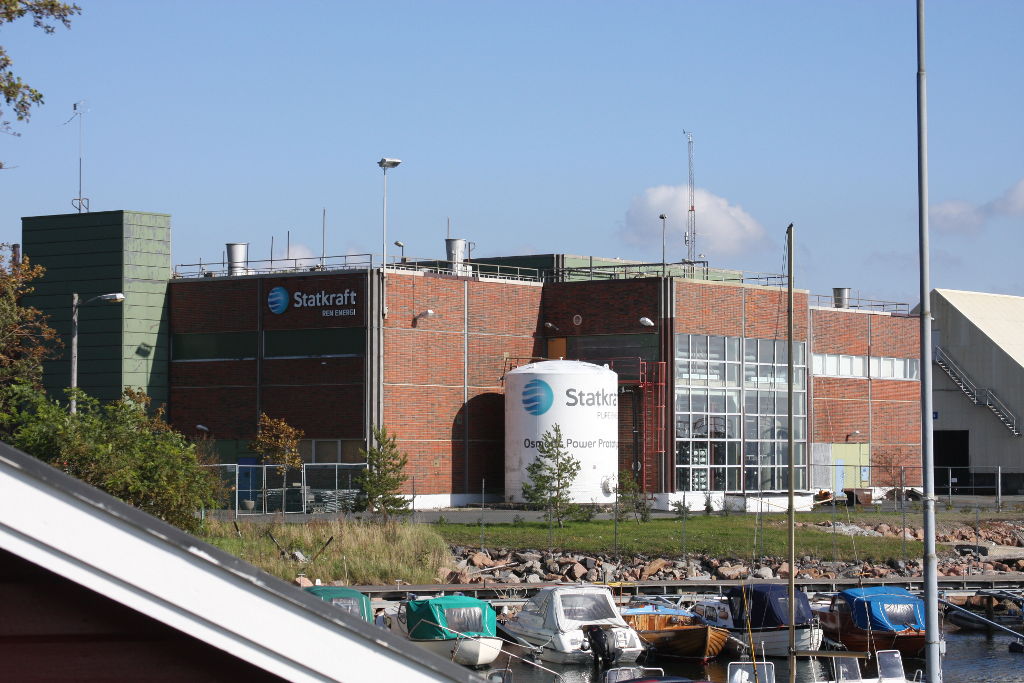
(Photo: Wikipedia)